An airlaid napkin jumbo roll is a parent reel: the substrate that napkin converters unwind, emboss, fold and cut. Buyers in Europe and the Middle East often call it a master roll, mother roll or parent reel — it is the same article, and it is not a finished napkin.
Quotations for jumbo rolls look deceptively simple: grammage, width, price per tonne. The variables that decide whether that reel runs cleanly at 60 m/min — or ends up as edge trim, dust and downtime — are never on the first page.
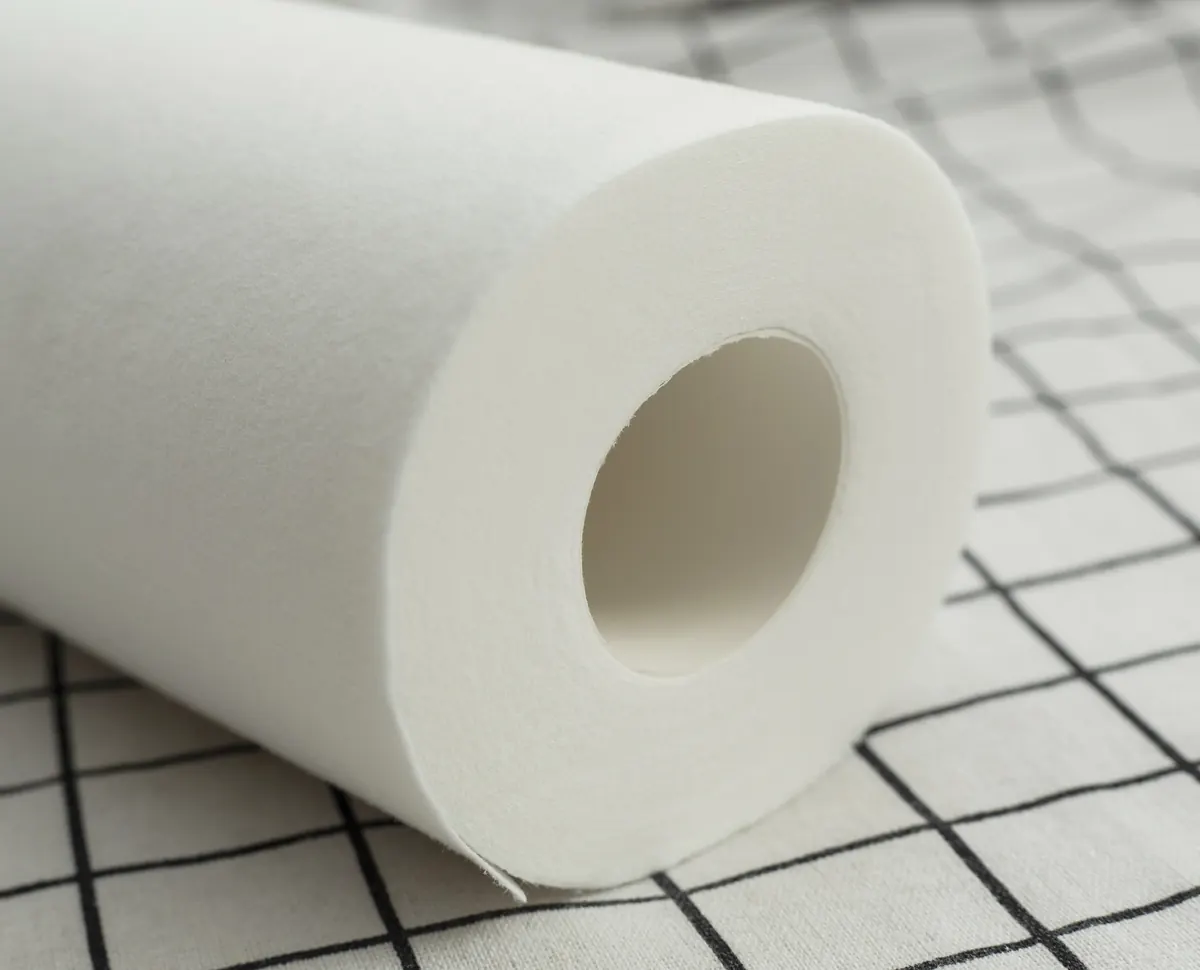
What you are actually buying
Four things travel with every reel, and each one can be specified or left to chance:
- Substrate. Latex-bonded airlaid (fluff pulp plus bicomponent fibre, bonded with latex) is the grade napkins need: soft, drapable, high bulk. Thermal-bonded airlaid is stiffer and suits wipes and table linen better. The two are not interchangeable on a folding line.
- Dimensions. Grammage 45–120 gsm, width 60–1,400 mm, core 76 mm as standard (152 mm on request for some European lines), outer diameter and roll weight typically 300–800 kg.
- Winding quality. Tension consistency across the reel, clean edge trim, and the number of splices. A reel with three splices is not the same purchase as a reel with none.
- Documentation. Declared gsm and width, batch test report, FSC® transfer certificate, and for EU shipments the due-diligence paperwork your importer will be asked for.
The five variables that move the price
1. Grammage — cost per tonne falls, cost per square metre rises
Pulp is the cheapest input in airlaid; latex, energy and machine time are the expensive ones. That is why a 100 gsm reel usually costs slightly less per tonne than a 55 gsm reel of the same width — the heavier sheet carries more cheap fibre. Your finished napkin, however, is priced per square metre, so a heavier sheet costs more per napkin. Optimise per square metre, not per tonne.
You pay for the full reel width and throw away whatever your converting line cannot use. Over a 20-tonne container, 5% trim is a tonne of paper.Trim waste, in one sentence
2. Width and trim waste — the largest lever you control
You pay for the full reel width and throw away whatever your converting line cannot use. If your finished napkin is 330 mm and your reel is 1,320 mm, you get four across with zero trim. Buy a 1,400 mm reel for the same napkin and you lose roughly 5% of the material before the first fold. Over a 20-tonne container that is a tonne of paper.
3. Embossing
Point-to-point and overall embossing add a converting step and a small amount of calliper. Expect USD 60–140 per tonne depending on pattern and roll engraving, plus a one-off engraving cost for a custom design.
4. Fibre and latex grade
Food-contact compliance, whiteness, wet strength and colour all change the furnish. Coloured or printed grades typically add USD 120–260 per tonne; PE-laminated waterproof grades add considerably more because they are a two-layer construction.
5. Volume and timing
A single tonne and a full container are different businesses. Airlaid demand peaks from March to June ahead of the European outdoor season, and capacity at that point is allocated rather than quoted. Ordering in Q4 for Q1 delivery is almost always cheaper.
Indicative pricing, 2026
Base prices move with pulp and latex indices, so we send the current price sheet on request instead of publishing a table that goes stale within a quarter.
Grade-by-grade base prices for 45–120 gsm, embossing and lamination adders, MOQ breaks and packing costs.
Request the price sheetTolerances worth writing into the contract
Most quality complaints on jumbo rolls are not defects — they are unspecified tolerances. Put these in the PO:
Qualifying a supplier in one sample round
You do not need a factory audit to separate a good reel from a bad one. Six checks on a single sample will do it:
- Hold a 30 cm section to the light. Fibre distribution should be even. Cloudy patches and thin spots become web breaks at speed.
- Weigh three 100 × 100 mm squares from the left edge, centre and right edge. The spread is your real gsm tolerance, not the one on the datasheet.
- Look at the edges. A clean trim is a sharp line. Feathered or crushed edges shed dust into your machine and jam the folder.
- Check roll hardness at both ends and the middle. Soft ends mean the reel will telescope on the unwinder.
- Run 100 m at production speed and count breaks, static and dust. This is the only test that predicts your line's efficiency.
- Ask for the batch record. A supplier who can trace the reel back to a production date, machine and operator is a supplier with a system; one who cannot is guessing.
Five mistakes that cost real money
- Comparing price per tonne only. A 5% cheaper reel with 5% trim waste is not cheaper.
- Not confirming core diameter. A 76 mm reel on a line built for 152 mm cores stops production on arrival.
- Going from sample to container. One pilot run of 200–500 kg costs little and settles gsm, tension and embossing before the deposit.
- Accepting ±5% grammage. At the low end your napkin is visibly thinner; at the high end you have paid for material you did not need.
- Leaving documentation to the end. EUDR due diligence, FSC® transfer certificates and food-contact reports should be agreed before the PO, not requested at the port.
MOQ, lead time and shipping
Standard white jumbo rolls start at one tonne per specification; a custom grammage, colour or embossing pattern starts at three tonnes because of the set-up. Lead time is 15–20 days after deposit for standard items and 25–30 days for custom work, with one additional week in peak season. A 20' container carries roughly 14–16 tonnes of jumbo rolls, depending on width and roll diameter. FOB Shanghai, CIF, DAP and DDP are all workable.
Documentation European buyers ask for
Napkins are food-contact articles, and since the EU deforestation regulation took effect the pulp chain matters too. Expect your supplier to provide: an FDA 21 CFR food-contact declaration with migration test reports, FSC® chain-of-custody and transfer certificates, RoHS and halogen-free statements, cytotoxicity and skin-irritation reports for hygiene applications, an EUDR-relevant due-diligence statement for the pulp, plus a batch certificate of analysis with every shipment.
If a supplier hesitates on any of these, that is your answer about how the next container will go.
Our own reel specifications — 45–120 gsm, 60–1,400 mm, 76 mm cores — are listed on the airlaid paper jumbo roll page, and the film-laminated grades under waterproof airlaid paper. If you are comparing structures rather than suppliers, start with the quality and testing section.
Request a Quote & Free Samples
Tell us your gsm, width and application — our engineers reply with a technical proposal and pricing within 24 hours.